

Dropping the "Good" and "Bad" Titles to Cholesterol

Why “Good” and “Bad” Cholesterol Is Too Simple
For years, cholesterol education has relied on one very simple rule: LDL is “bad” and HDL is “good.” It is memorable, but it can also be misleading. A low LDL does not always mean everything is fine, and a high HDL does not give you a free pass. Cardiovascular risk is more complicated than that.

LDL-C tells us about cargo, not necessarily traffic
LDL tells us how much cholesterol is being carried inside LDL particles. Using the highway analogy, it tells us how much cargo is moving down the road, but not necessarily how many vehicles are carrying it. That is where ApoB can add useful information. Each atherogenic (plaque-forming) particle carries one ApoB, so ApoB gives us an estimate of how many plaque-forming particles are circulating.
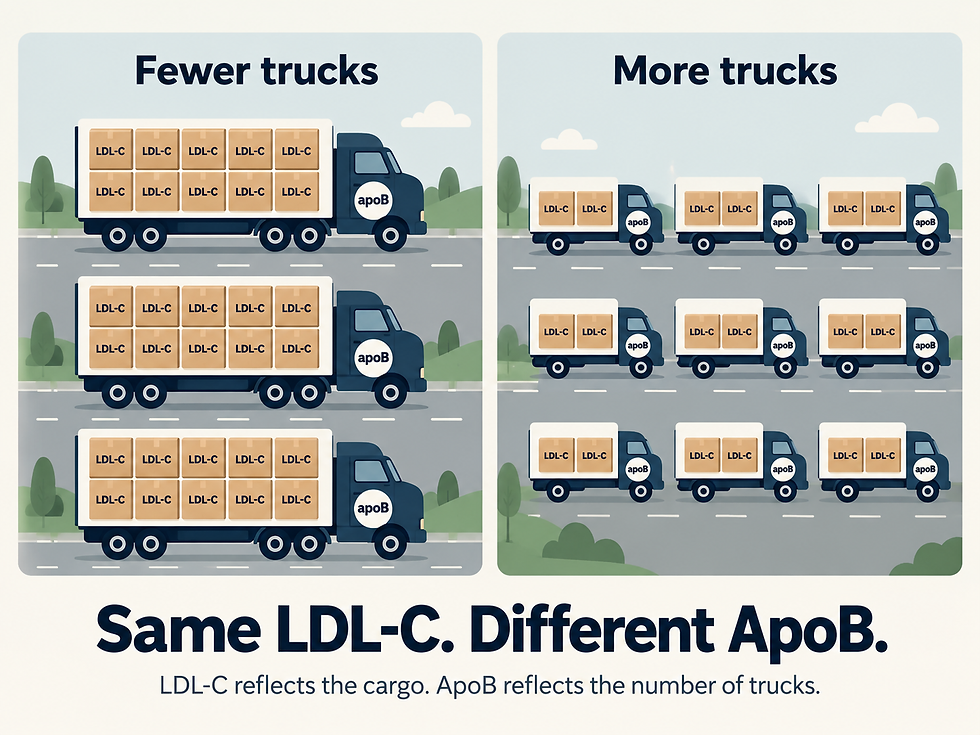
Sometimes LDL and ApoB tell a similar story. Sometimes they do not. A person can have a fairly unremarkable LDL but still have a large number of ApoB particles. That mismatch is more common in people with insulin resistance, type 2 diabetes, elevated triglycerides, or extra weight around the middle.
HDL is not a free pass
HDL is also more complicated than its “good cholesterol” nickname suggests. HDL particles are involved in transporting cholesterol away from tissues and back toward the liver, which is an important job. But having a high HDL does not erase the risk associated with a high LDL, ApoB, or other atherogenic particles.
Think of HDL as part of the cleanup crew. More cleanup trucks do not make heavy traffic harmless. This is also why medications that simply raise HDL have not consistently reduced heart attacks and strokes. HDL appears to be much more complex than a simple “higher is always better” number.

Cholesterol itself is not the villain
It is also worth remembering that cholesterol itself is not inherently bad. Your body needs cholesterol to build cell membranes, hormones, bile acids, and vitamin D. The real issue is where cholesterol is being carried, how many atherogenic particles are circulating, and whether those particles are getting into the artery wall. That is a very different story than simply labeling one cholesterol number good and another bad.
Look at the whole traffic pattern
A better way to think about your lipid panel is to ask a few broader questions. How much atherogenic cholesterol is circulating? How many atherogenic particles are on the road? Do LDL, non-HDL, and ApoB tell the same story? And what do those numbers mean in the context of your overall cardiovascular risk?
LDL still matters. HDL still matters. But neither should be interpreted in isolation. The goal is not to praise one number and fear another. The goal is to understand the whole traffic pattern.
What can you do about these numbers?
The good news is that LDL and ApoB can often be improved with many of the same strategies. Increasing soluble fiber, replacing saturated fats with unsaturated fats, choosing more plant proteins, and building meals around minimally processed plant foods can all help lower the amount of atherogenic cholesterol and the number of plaque-forming particles circulating in the blood. Depending on someone’s genetics and overall risk, medication may also be part of the picture.
HDL is a little different. We do not usually target HDL directly, but regular exercise has been shown to modestly raise HDL in some people and may also improve how well HDL functions. So rather than chasing a higher HDL number, it is more helpful to focus on the habits that improve the whole cardiovascular picture: move regularly, eat well, manage blood pressure and blood sugar, and keep LDL and ApoB in a healthy range.


Comments